The importer owns the tariff code, and a single wrong code repeats quietly across every entry. What misclassification really costs in the UK and the US - recovered duty, penalties, border delays and forfeited trade-agreement benefits.
A wrong tariff code is not a clerical slip that gets corrected at the border and forgotten. It is a breach of a legal obligation that sits with the importer, and because most businesses reuse the same code on every shipment of a product, a single error repeats quietly across every entry until someone notices. When someone does notice, usually a customs authority, the exposure reaches backwards across years of past imports, not just the shipment in front of you. This is what actually happens, in the UK and the US, when the code is wrong.
The short version
The importer is responsible for the code, so the importer carries the consequences. Those consequences fall into four groups: recovered duty and tax on past entries, penalties that scale with how careless the error was, disruption at the border, and forfeited trade-agreement benefits. The financial tail is usually far larger than the duty difference on any single shipment, because the error compounds over time and reaches back over past entries when it is found.
What happens in the UK
In the UK, HMRC can audit the commodity codes a business has used and, where it finds an error, issue a post-clearance demand for the duty and import VAT that should have been paid. That demand covers past entries, not only future ones, and interest is added. HMRC has been clear that it is moving towards audit-based enforcement rather than checks at the border, which means the risk is not a spot check on one shipment but a review of your declaration history, and the business is expected to hold the audit trail that justifies each code.
The sums are not trivial. In one tribunal case, a business that had classified a product under a duty-free code was reassessed by HMRC to a dutiable one and faced a demand of roughly £109,000 in customs duty and around £22,000 in import VAT across a period of past imports. That is a single product line, reclassified after the fact. Scale that logic across a full range and the exposure grows quickly.
What happens in the US
US law requires the importer of record to exercise reasonable care in classifying goods. Crucially, customs does not need to prove you meant to get it wrong. A good-faith but poorly executed classification can still be found negligent, and negligence carries a price under the main customs penalty statute. That standard applies from your very first entry, which is why brands new to the US market are exposed earlier than they expect. The penalties scale with culpability: for negligence, up to twice the lost revenue (or 20 per cent of the value of the goods where no revenue was lost); for gross negligence, up to four times the lost revenue (or 40 per cent); and for fraud, up to the full domestic value of the merchandise. Back duty can be recovered across a five-year window for negligence.
This is not theoretical enforcement. Customs collected over 600 million dollars in penalty claims related to misclassification and undervaluation in 2025, and the trade consensus is that 2026 is the year enforcement steps up, with more scrutiny of tariff evasion rather than less. In an environment of layered tariffs, where the effective duty on some goods now stacks well beyond the headline rate, the incentive for customs to check classification has never been higher.
There is one piece of good news worth knowing: in the US, an importer who finds and voluntarily discloses a classification error before customs does typically faces sharply reduced penalties, often limited to interest on the unpaid duty. Finding your own errors first is materially cheaper than having them found for you, which is an argument for checking your back catalogue rather than hoping it holds.
The quiet risk: one wrong code, repeated
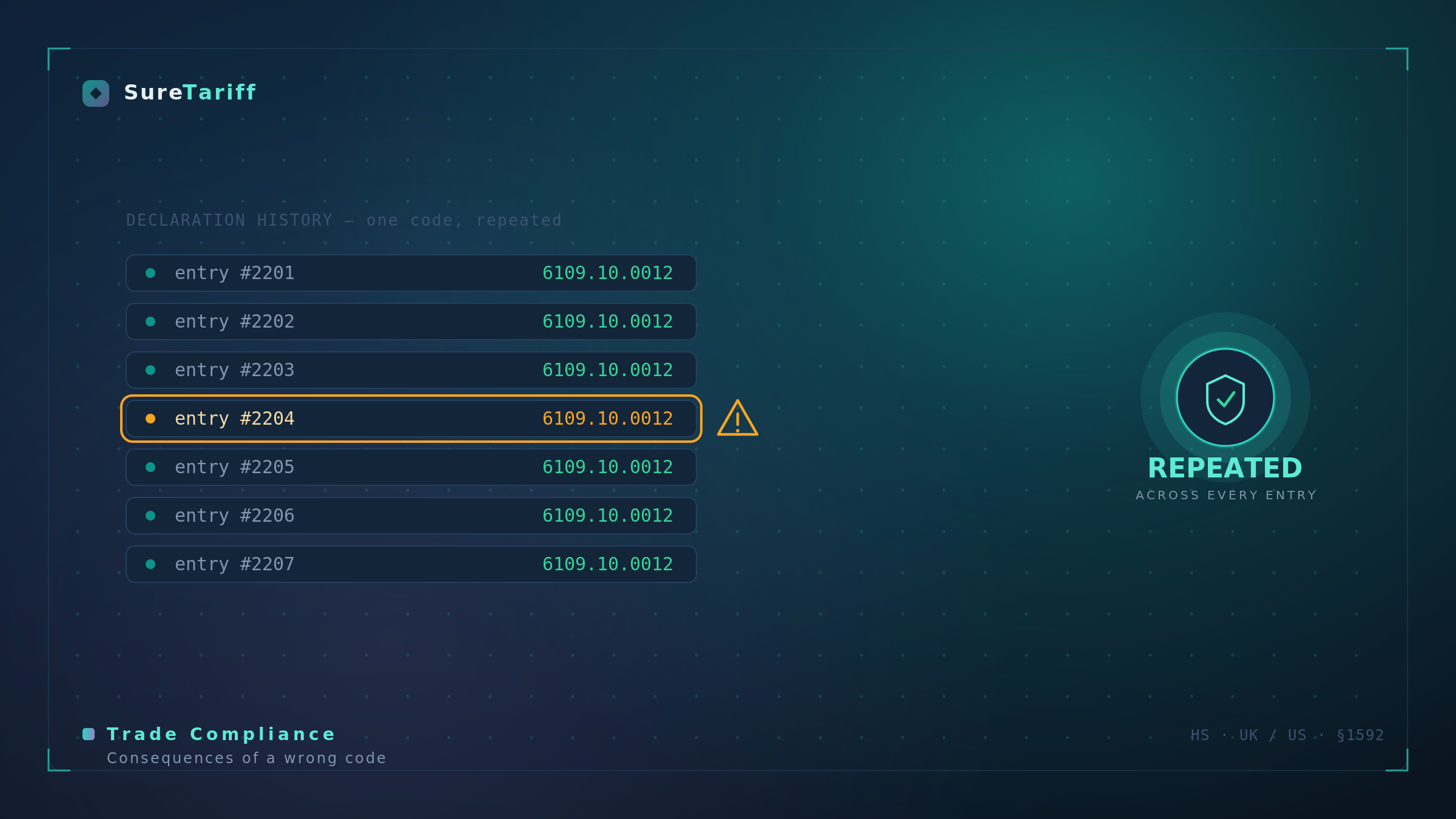
The reason misclassification is dangerous is not the single wrong entry, it is the repetition. A business classifies a product once, saves the code, and applies it to every shipment of that product thereafter. If the code was wrong, every one of those entries was wrong, and the error sat undetected for months or years while it accumulated. When it surfaces, the correction is not one entry, it is all of them.
We see this directly. One brand we work with, importing into both the UK and the US, let us re-run several thousand products from its historic ranges against the codes it had previously used. Where our classification disagreed with the code on file, it was usually our code that stood up to scrutiny. Each of those disagreements represented a duty the business had potentially over- or under-paid, and an entry it would have found hard to defend if asked. None of it was deliberate. It was the ordinary result of classifying a large, varied range by hand, under time pressure, against rules that keep moving. That is precisely the risk that hides in a back catalogue nobody has re-examined.
Beyond penalties
The duty and the penalties are the visible costs. Others are less obvious and can hurt as much.
A wrong code can hold a shipment at the border. Customs systems flag entries that look inconsistent, and a flagged shipment stops moving while charges accrue, with demurrage at the port commonly running in the range of 75 to 150 US dollars per container per day, and detention adding more once the container leaves. A wrong code can also forfeit a preferential duty rate under a free trade agreement, because the preference is tied to the correct classification and origin; a single wrong digit can move a product out of the qualifying line and turn a zero rate into a full one. And a wrong code quietly corrupts every commercial calculation built on it, because a landed cost based on the wrong duty rate is a landed cost that was never real, which means the margin was never real either.
The point
Classification is a compliance obligation with a long financial tail, not a data-entry task. The way to stay out of trouble is not to hope the codes are right, it is to classify correctly in the first place and to keep the reasoning on record, so that if a code is ever challenged you can show how it was reached. A modern classification service does exactly that: it returns each code with a confidence figure and a plain-language explanation of why it was chosen, and where a product is genuinely ambiguous it says so and sets out the options rather than guessing. That record is what turns a code from a liability you cannot defend into a decision you can.
Interested in learning more? Get in touch to discuss how we can help.
Join a demo