Your existing tariff codes travel only as far as the first six digits. What changes when a UK or Canadian brand enters the US: national codes, the closed de minimis route, origin rules, importer of record, and reasonable care.
A brand that has been importing successfully for years can arrive in a new market and find that almost none of its hard-won knowledge transfers. The product has not changed. The supply chain has not changed. But the codes, the duty rates, the entry requirements and the legal responsibilities are all different, and the assumptions that worked at home quietly stop being true. A UK or Canadian brand opening up in the United States is the most common version of this, and it is where the most expensive lessons get learned. Here is what actually changes, and what to settle before the first shipment rather than after.
The short version
Your existing tariff codes travel with you only as far as the first six digits. Everything after that is national, and it is where the duty rate is decided. On top of that, the United States has closed the duty-free route for low-value parcels, applies its own rules for deciding where a product comes from, and holds the importer to a specific legal standard of care. Each of those is survivable if you plan for it. The damage comes from assuming your home-market setup carries across.
Lesson one: your existing codes only get you halfway
This is the mistake that costs the most, because it looks like a saving. A brand with a fully classified UK range assumes the work is done and hands those codes to a US freight forwarder or drops them into a US entry.
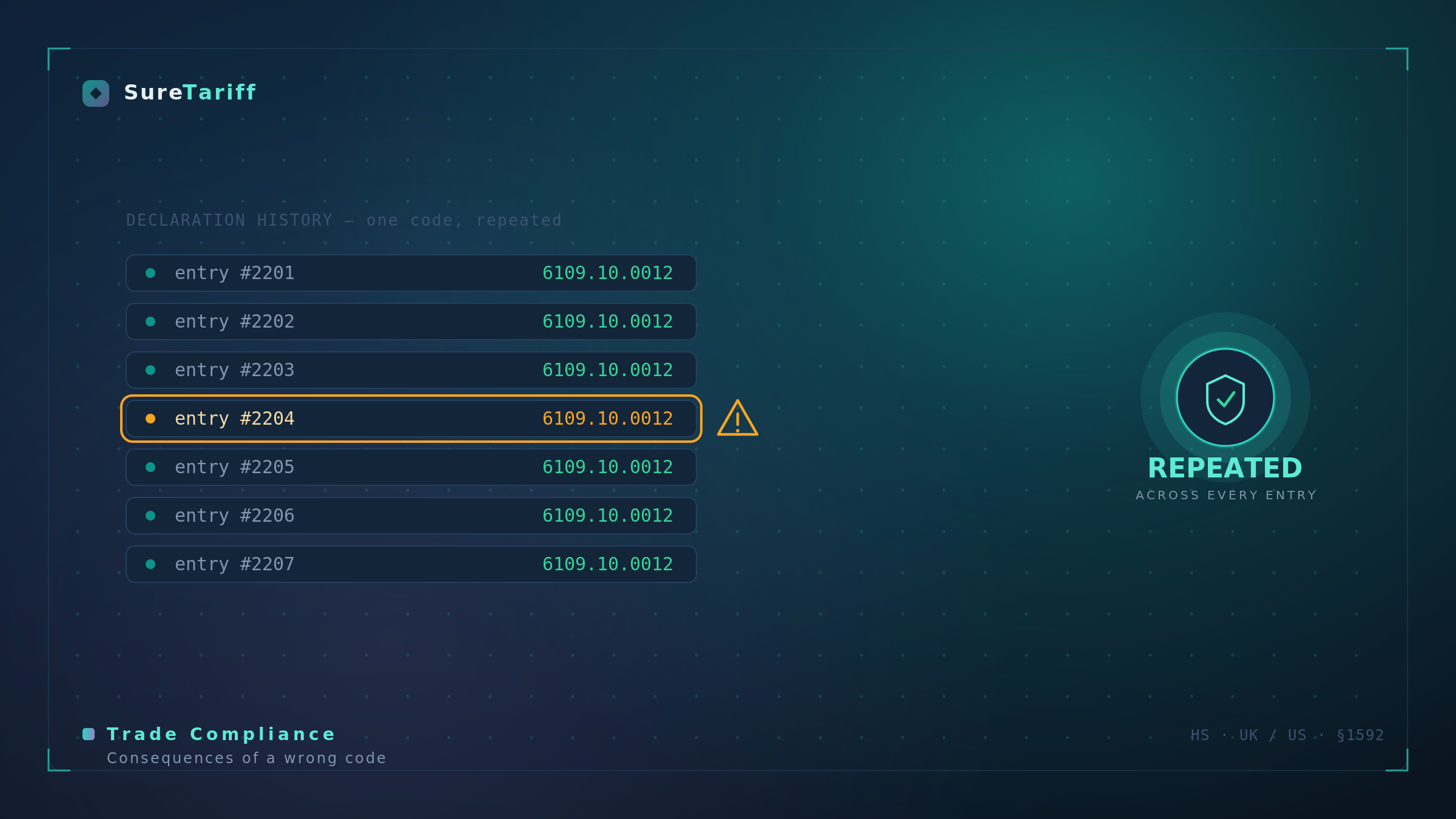
Only the first six digits are shared. The Harmonized System is international to six digits, and every country builds its own detail on top. The UK commodity code and the US HTSUS code are both ten digits, but the final four are separate national schemes. A UK code's last four digits carry no meaning in a US entry, and the US line under the same six-digit heading may split the product differently, at a different rate, with its own statistical detail. The US schedule alone runs to roughly 17,000 ten-digit lines.
So a fully classified UK range gives you six digits of a ten-digit answer. That is a genuine head start, and it is not a finished job. The right approach is to treat the new market as a fresh classification of the same products, done against that market's tariff, using the product data you already hold. The attributes have not changed, so the work is not starting from nothing, but the answer has to be produced against the US schedule rather than translated from the UK one.
It works in both directions. A US brand entering the UK faces exactly the same halfway problem in reverse.
Lesson two: the duty-free parcel route has closed
This one has caught out a large number of brands, particularly those that tested a new market by shipping direct to consumers before committing to bulk imports.
For years, the United States allowed shipments valued at 800 dollars or less to enter duty-free with minimal formality, under what was known as Section 321 or de minimis. Many overseas brands built their US entry strategy on it: ship parcels individually, pay nothing, see whether the market responds. That route is gone. The exemption was suspended for China and Hong Kong in May 2025 and for all remaining countries from 29 August 2025, and the suspension has since been confirmed as continuing, with legislation pointing towards permanent repeal.
The practical effect is significant. Low-value shipments into the US are now subject to applicable duties, and every shipment requires formal or informal customs entry through the customs electronic system, filed by an authorised filer, carrying a full ten-digit HTSUS code. That applies to a one dollar parcel as much as a 799 dollar one. A brand that previously shipped thousands of small parcels without ever classifying a product now needs a correct US code for every item it sells, and needs to have priced its products in the knowledge that duty applies.
If your US market-entry plan was written before late 2025, this is the assumption most likely to be out of date in it.
Lesson three: origin is not where you ship from
The second expensive assumption is that a product shipped from Canada is Canadian, or that goods sent from a UK warehouse are British. Customs does not work that way. Country of origin is where the goods were produced or last substantially transformed, not where they were stored, consolidated or dispatched.
For a Canadian brand this matters enormously, because it decides whether USMCA preference applies. Goods genuinely produced in Canada may enter the United States duty-free under the agreement. Goods made in Asia, warehoused in Canada and shipped south do not become Canadian by passing through, and attract the ordinary rate for their classification plus whatever additional measures apply. Simply repacking or lightly assembling in a country does not usually change origin.
Two further points catch people out. First, determining a product's origin is not the same as qualifying for a trade agreement: USMCA has its own product-specific rules of origin, and a good has to meet those rules, not merely be marked as Canadian. For clothing and textiles those rules are demanding, generally requiring that the yarn and fabric originate in the region as well as the making-up, with limited allowances for small quantities of non-originating material. Second, textiles and apparel have their own origin regime in US law, which is more prescriptive than the general test applied to other goods.
The lesson is to establish origin properly, on evidence from your suppliers, before you claim any preference. Relying on an exporter's word without verifying it has been found, in US case law, to fall short of the standard expected of an importer.
Lesson four: decide who the importer of record is, deliberately
Every US shipment needs an importer of record, the party legally responsible for the entry, the duty and the accuracy of what is declared. New entrants often let this be decided by default, by a forwarder or by whichever incoterm appeared on a quote, and only later discover what they signed up to.
There are broadly two routes. A brand can establish a US entity and import through it, which is the cleanest structure and gives access to the ordinary domestic bonding and trade programmes. Or it can act as a non-resident importer, obtaining a customs-assigned importer number and posting a customs bond, usually with a licensed US broker handling the filings. Both routes work, both require a bond, and the choice has tax, liability and operational consequences well beyond customs. Worth noting too that proposed legislation has been introduced that would tighten the requirements on non-resident importers, so this is an area to take current professional advice on rather than settle once and forget.
The related decision is commercial: which incoterm you sell on. If you sell delivered duty paid, you are carrying the duty, and a classification error lands on your margin. If you sell on terms where the buyer imports, the responsibility sits with them, which changes your pricing and your risk. Neither is wrong, but choosing by accident is.
Lesson five: reasonable care is a standard, not a sentiment
UK importers are used to being responsible for their commodity codes, and HMRC can audit and issue demands for underpaid duty. The US expresses the obligation differently, and the difference matters. US law requires the importer of record to exercise reasonable care in classifying and valuing goods. Customs does not have to show you intended to get it wrong: a good-faith error, poorly executed, can still be treated as negligence, with penalties calculated as a multiple of the lost revenue, and back duty recoverable over a five-year window.
For a brand new to the market, that has a practical implication. Being new is not a defence. What counts as reasonable care includes using the resources available to you, keeping records of how a code was reached, and correcting errors when you find them. The corollary is helpful: an importer who identifies and voluntarily discloses an error before customs finds it typically faces substantially reduced penalties. Checking your first year of entries is a cheap exercise compared with having them checked for you.
Lesson six: classify before you price, not after
Everything above converges on one operational point. A new market has a different duty rate on the same product, possibly a preference you do or do not qualify for, and now a duty liability on parcels that used to travel free. All of that is landed cost, and landed cost decides whether your US price list makes money.
Brands routinely set new-market pricing on the home-market cost base plus a rough allowance for duty, then discover the real rate after the goods land. By then the price is published. The alternative is to classify the range against the new market's tariff during planning, while pricing is still open, so the duty rate is an input to the decision rather than a surprise that follows it.
A practical sequence
Before the first commercial shipment into a new market, settle these in order: classify your range against that market's own tariff schedule rather than translating existing codes; establish and evidence the country of origin of each product, and check properly whether it qualifies for any preference; decide and set up your importer of record structure and bond; choose the incoterms you will sell on; then build your landed cost and pricing on those numbers. Take professional advice on the entity, tax and bonding questions, which sit outside classification and have consequences of their own.
None of this is a reason not to expand. It is a reason to do the classification work up front, where it is cheap, rather than discovering it at a port, where it is not.
Doing the classification part properly
The classification piece is the one that scales badly by hand, because entering a new market means re-classifying your entire range, not a handful of products. That is exactly where working from the product data you already hold pays off: the fabric, construction, composition and end-use attributes that produced your home-market codes are the same attributes the new market's schedule needs, so a second market should not mean a second full manual exercise.
SureTariff is live for both UK and US determination, so the same product data produces the code for each market, each with a confidence figure and a plain-language explanation of why that code was chosen. Where a product's data leaves a genuine question open, the system says so and sets out the candidate codes rather than guessing, which is precisely the transparency you want on record when you are new to a market and the standard being applied to you is reasonable care.
Interested in learning more? Get in touch to discuss how we can help.
Join a demo